Your submitted audiobook must be narrated by a human.
Tuesday, May 18, 2021
Thursday, April 29, 2021
U.S. Tells Citizens to Leave India as Covid Crisis Deepens
Featured Contents

India, officially the Republic of India, is a country in South Asia. It is the second-most populous country, the seventh-largest country by land area, and the most populous democracy in the world. It consists of 28 states and 8 union territories.
Wednesday, April 14, 2021
Tuesday, April 6, 2021
CDC tracking shows that the Brazilian variant accounts for 434 cases of COVID-19 in the U.S. Brazil's COVID-19 death surge set to pass the worst of record U.S. wave
RIO DE JANEIRO, April 6 (Reuters) - Brazil's brutal surge in COVID-19 deaths will soon surpass the worst of a record January wave in the United States, climbing well beyond an average 3,000 fatalities per day, scientists predict, as contagious new variants overwhelm hospitals.
Brazil's overall death toll trails only the U.S. outbreak, with nearly 333,000 killed, according to Health Ministry data, compared with more than 555,000 dead in the United States.
'A biological Fukushima': Brazil COVID-19 deaths on track to pass worst of U.S. wave
RIO DE JANEIRO (Reuters) - Brazil’s brutal surge in COVID-19 deaths will soon surpass the worst of a record January wave in the United States, scientists forecast, with fatalities climbing for the first time above 4,000 in a day on Tuesday as the outbreak overwhelms hospitals.
Monday, March 29, 2021
STRANGE, DISTANT SPACE OBJECT IS SENDING OUT ULTRA-LOW FREQUENCY RADIO SIGNALS RESEARCHERS SAY THE OBJECT LOOKS LIKE A COSMIC JELLYFISH.
Cosmic Archeology
As you can imagine, studying radio frequencies from 340 million lightyears away presents its own special set of challenges.
“We’ve had to undertake some cosmic archeology to understand the ancient background story of the jellyfish,” said Hodgson in the press release.
However, they’ve been able to develop a working theory of where it came from: supermassive blackholes that created “powerful jets of plasma” about two billion years ago.
“This plasma faded, went quiet, and lay dormant,” Hodgson said. “Then quite recently, two things happened — the plasma started mixing at the same time as very gentle shock waves passed through the system. This has briefly reignited the plasma, lighting up the jellyfish and its tentacles for us to see.”
The Right Tool for the Job
Hopefully, we won’t have to wait long until researchers discover more about the cosmic jellyfish since construction on the new Square Kilometre Array (SKA) has begun. Researchers anticipate that the radio telescope will give us a far better look at the object.
“The SKA will be thousands of times more sensitive and have much better resolution than the MWA, so there may be much other mysterious radio jellyfish waiting to be discovered once its operation,” said Professor Melanie Johnston-Hollitt, the paper’s co-author and Hodgson’s supervisor, in a press release.
The radio telescope will also give researchers a look at some of the first galaxies to have ever emerged in the universe. It’d be cool, though, if they discovered a cosmic shark or whale to join USS Jellyfish in our space aquarium.
Friday, March 5, 2021
Harvard sued by descendant of slave for profiting from photos
Harvard sued by a descendant of a slave for profiting from photos
Published21 March 2019
IMAGE COPYRIGHTThe descendant of a black American slave has sued Harvard University, claiming the college profits from images of her alleged ancestor.
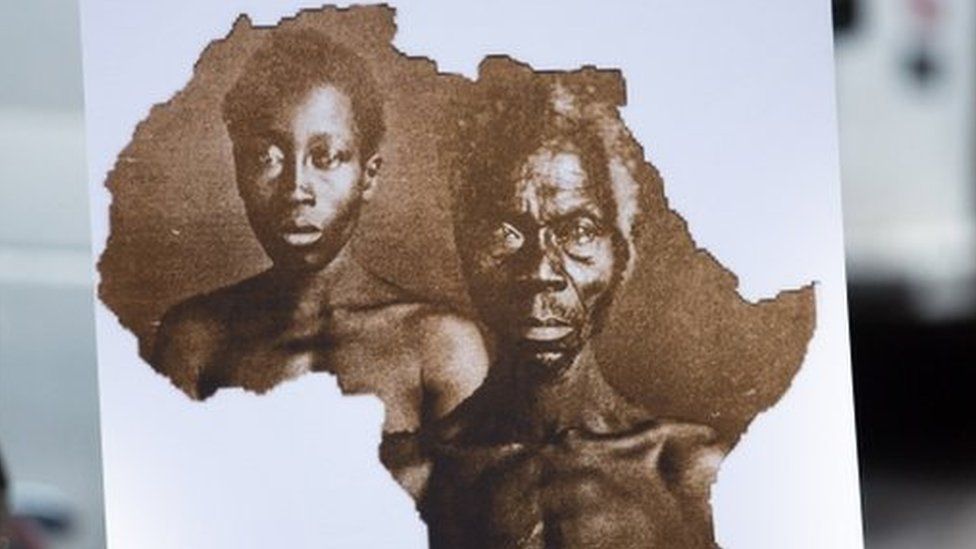
The pictures, commissioned in 1850 by a professor seeking to prove that black people were inferior, is believed to among the first photos of US slaves.
Tamara Lanier's lawsuit says the school is "perpetuating the systematic subversion of black property rights".
It comes as several US universities grapple with their racist histories.
Harvard spokesman Jonathan Swain told the Associated Press the university "has not yet been served, and with that is in no position to comment on this complaint".
The images, which were daguerreotypes, an early type of photograph, were made in a studio in South Carolina, and show a man known as Renty, stripped naked to the waist, along with his daughter Delia.
The pictures were commissioned by Harvard biologist Louis Agassiz, who used them to argue for slavery in the US.
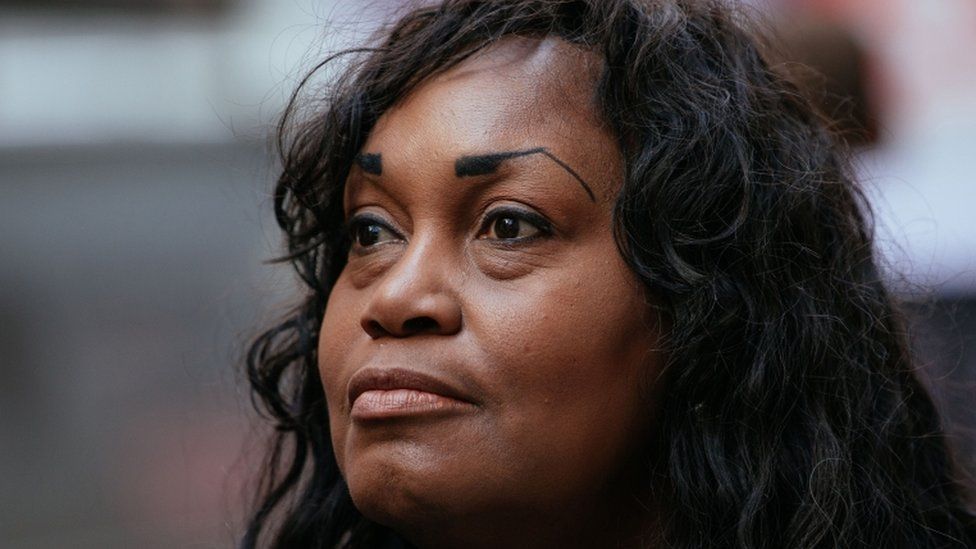
Ms. Lanier, a retired probation officer who claims to be the great-great-great-granddaughter of Renty, asks in her lawsuit for Harvard to return the images to her family, pay unspecified damages to her and acknowledge that it was "complicit in perpetuating and justifying the institution of slavery".
It remains unclear whether Ms. Lanier can prove her genetic lineage to the man she calls "Papa Renty" and grew up hearing bedtime stories about.
IMAGE COPYRIGHTREUTERS"What I hope we're able to accomplish is to show the world who Renty is," she said at a news conference in New York City on Wednesday.
"I think this case is important because it will test the moral climate of this country and force this country to reckon with its long history of racism."
According to her complaint: "By denying Ms Lanier's superior claim to the daguerreotypes, Harvard is perpetuating the systematic subversion of black property rights that began during slavery and continued for a century thereafter."
The images were discovered in 1976 in a storage attic at Harvard's Peabody Museum of Archaeology and Ethnology.
According to unearthed records, Renty was born in Congo.
IMAGE COPYRIGHTEPAMs Lanier says she attended a 2017 conference at Harvard on the links between academia and slavery in which an image of Renty was projected over the speakers.
Ta-Nehisi Coates, who wrote a popular essay about paying reparations to black Americans for slavery and discrimination, attended the conference and told the New York Times that he understands why Ms Lanier was offended.
"That photograph is like a hostage photograph," he said.
"This is an enslaved black man with no choice being forced to participate in white supremacist propaganda - that's what that photograph was taken for."
The suit also alleges Harvard requests a large licensing fee to use the image and points to a book the university sells, From Site to Sight: Anthropology, Photography, and the Power of Imagery, for $40 (£31).
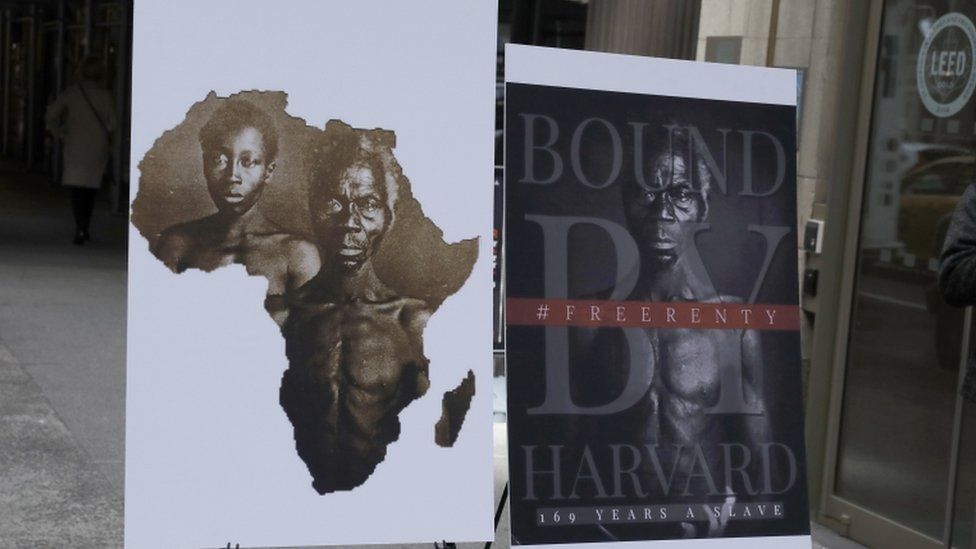
A lawyer for Ms Lanier, civil rights attorney Benjamin Crump said: "These photographs make it clear that Harvard benefited from slavery then and continues to benefit now. By my calculation, Renty is 169 years a slave. When will Harvard finally set him free?"
Harvard is one among several elite US universities criticised for failing to recognise their racist legacies.
In 2016 a member of Yale University's kitchen staff was arrested after he smashed a stained glass window depicting slaves toiling in a field, telling police that "no employee should be subject to coming to work and seeing slave portraits on a daily basis".
The charges against Corey Menafee, who is black, were later dropped.
In 2017, Georgetown University in Washington DC apologised for selling 272 slaves in the early 1800s and offered an admissions advantage to the descendants of the men, women and children who were sold in order to cancel the university's debt.
Harvard Law School removed its official seal in 2016 after it was found to have been used as the family crest of a notoriously brutal slave owner, Isaac Royall, who was known to have ordered 77 enslaved people to be burned alive. Images of Slaves Are Property of Harvard, Not a Descendant, Judge Rules
The woman who says the enslaved people are her ancestors plans to appeal the decision “about the patriarch of a family, a subject of bedtime stories.”
Tamara Lanier sued Harvard University for ownership of daguerreotypes of slaves who she said were her ancestors.
Tamara Lanier sued Harvard University for ownership of daguerreotypes of slaves who she said were her ancestors. Credit...Karsten Moran for The New York Times
Anemona Hartocollis
By Anemona Hartocollis
Published March 4, 2021
Updated March 5, 2021
A Massachusetts judge has dismissed a lawsuit by a woman claiming that she, not Harvard University, is the rightful owner of haunting images of an enslaved father and daughter who she says were her ancestors.
The judge acknowledged that the daguerreotypes had been taken under “horrific circumstances” but said that if the enslaved subjects, Renty and Delia, did not own the images when they were taken, then the woman who brought the lawsuit, Tamara Lanier, did not own them either.
“Fully acknowledging the continuing impact slavery has had in the United States, the law, as it currently stands, does not confer a property interest to the subject of a photograph regardless of how objectionable the photograph’s origins may be,” Justice Camille F. Sarrouf of Middlesex County Superior Court wrote in a judgment filed Tuesday.
Ms. Lanier said on Thursday that she planned to appeal and that the judge had “completely missed the humanistic aspect of this, where we’re talking about the patriarch of a family, a subject of bedtime stories, whose legacy is still denied to these people.”
Legal BattleHaunting and voyeuristic images are at the center of a dispute with Harvard over who should own the fruits of American slavery.
Renty and Delia were stripped to the waist in the daguerreotypes, taken in 1850, and treated as scientific evidence of a discredited theory that Black people were inferior. The images, part of a project commissioned by Louis Agassiz, a prominent Harvard professor, and zoologist, were hidden away in a Harvard museum until 1976. Their discovery caused a sensation because they were thought to be the earliest known photographs of American slaves.
A program for a 2017 conference at Harvard bears the image of Renty, a slave from whom Ms. Lanier says she descended.
A program for a 2017 conference at Harvard bears the image of Renty, a slave from whom Ms. Lanier says she descended.Credit...Karsten Moran for The New York Times
For the purposes of the lawsuit, neither Harvard nor the judge disputed Ms. Lanier’s evidence that she was a direct descendant of Renty. But, Justice Sarrouf wrote, “It is a basic tenet of common law that the subject of a photograph has no interest in the negative or any photographs printed from the negative.”
The judge also rejected Ms. Lanier’s claim that Harvard had exploited the photographs for financial gain — for example, by putting Renty’s image on the cover of a book — saying that the right to control commercial use of the photographs had expired with the deaths of the subjects.
Saturday, January 30, 2021
WHO team visits Wuhan hospital that had early virus patients
WUHAN, China (AP) — A World Health Organization team visited a hospital on Friday where China says the first COVID-19 patients were treated more than a year ago as part of the experts’ long-awaited fact-finding mission on the origins of the coronavirus.
The WHO team members and Chinese officials earlier had their first in-person meetings at a hotel ahead of field visits in and around Wuhan's central city in the coming days.
“First face to face meeting with our colleagues. Correction: facemask to facemask given the medical restrictions,” Dutch virologist Marion Koopmans tweeted in the morning.
She said they were discussing their program of visits. Chinese team leader “prof. Wannian” was joking about some technical glitches, an apparent reference to top Chinese epidemiologist Liang Wannian, who has been a leader of China’s response team.
“Nice to see our colleagues after lengthy Zoom meetings,” Koopman tweeted. The visiting researchers held video meetings during 14 days of quarantine after they arrived in China. They came out of quarantine on Thursday.
Members of the team left the hotel by car and a short time later entered the Hubei Provincial Hospital of Integrated Chinese and Western Medicine gates. According to China’s official account of its response to the initial outbreak, Dr. Zhang Jixian first reported cases of what was then known as “pneumonia of unknown origin” at the hospital on Dec. 27, 2019.
WHO said earlier on Twitter that the team requested “detailed underlying data” and planned to speak with early responders and some of the first COVID-19 patients. It also planned to visit markets such as the Huanan Seafood Market linked to many of the first cases, the Wuhan Institute of Virology, and laboratories at facilities such as the Wuhan Center for Disease Control.
The team’s mission has become politically charged, as China seeks to avoid blame for alleged missteps in its early response to the outbreak.
“All hypotheses are on the table as the team follows the science in their work to understand the origins of the COVID19 virus,” WHO tweeted.
Confirmation of the origins of the virus is likely to take years. Pinning down an outbreak’s animal source typically requires exhaustive research, including taking animal samples, genetic analysis, and epidemiological studies.
One possibility is that a wildlife poacher might have passed the virus to traders who carried it to Wuhan. The Chinese government has promoted theories, with little evidence, that the outbreak might have started with imports of frozen seafood tainted with the virus, a notion roundly rejected by international scientists and agencies.
A possible focus for investigators is the virology institute in the city. One of China’s top virus research labs built an archive of genetic information about bat coronaviruses after the 2003 outbreak of Severe Acute Respiratory Syndrome or SARS.
The first clusters of COVID-19 were detected in Wuhan in late 2019. China has since reported more than 89,000 cases and 4,600 deaths, with new cases largely concentrated in its frigid northeast. Local lockdowns and travel restrictions were being imposed to contain the outbreaks.
New local transmission cases continue to fall, with just 36 announced on Friday, as far fewer Chinese than usual appear willing to travel for Lunar New Year.
Associated Press photographer Ng Han Guan in Wuhan, China, and video journalist Sam McNeil in Beijing contributed to this report.
Total cases 1.1M 1,100,000 +6,480 | Recovered - | Deaths 16,332 16,332 +225 |
Total cases 3.29M 3,290,000 +19,735 | Recovered - | Deaths 40,192 40,192 +665 |
Total cases 26M 26,000,000 +166K | Recovered - | Deaths 437K 437,000 +3,600 |
Total cases 102M 102,000,000 | Recovered 56.6M 56,600,000 | Deaths 2.21M |